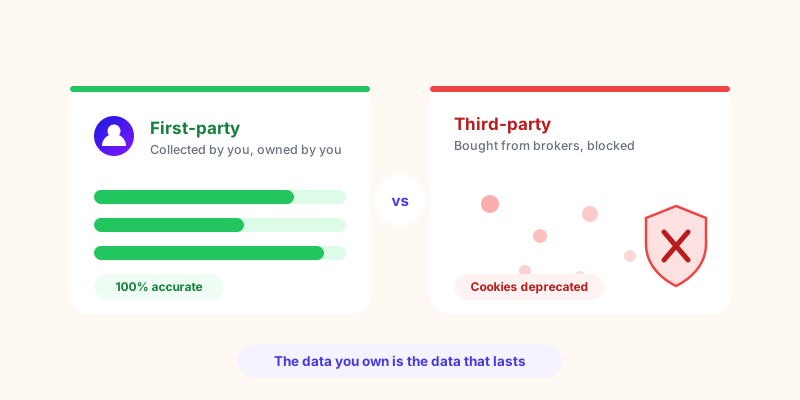
Every company sits on data about the people it serves. What separates a data strategy that lasts from one that quietly crumbles comes down to a single question: how much of that data do you actually own and control? That, underneath the jargon, is what the labels first-party, second-party, and third-party really describe.
This guide explains the difference between the three and why the balance is shifting toward the data you own. Because the most valuable first-party asset most teams have, the record of what their audience actually does on their own website, is also the one they most often hand straight to a third party without realizing it.
The three types of data, defined
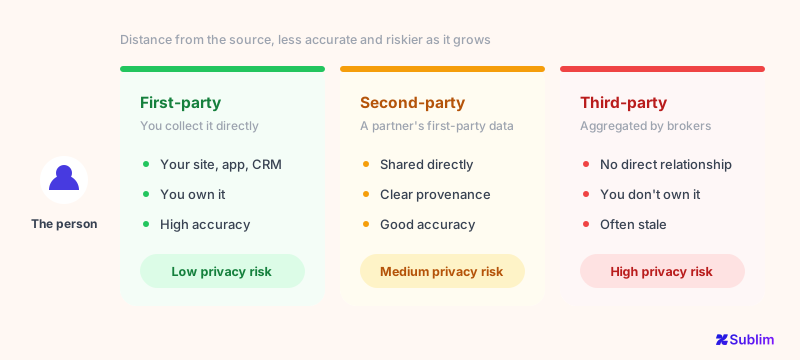
The labels describe one thing only: how far the data is from the person it describes. The closer you are to the source, the more you can trust it and the more you actually own it.
- First-party data is what you collect directly from your own audience, through your own channels: your website, your app, your CRM, your purchase history, your surveys. You own it, you know exactly where it came from, and it was gathered inside a relationship the person chose to have with you.
- Second-party data is simply someone else's first-party data, shared or bought directly from the company that collected it. A hotel chain and an airline swapping loyalty data through a direct partnership is the classic example. There is no broker in the middle, so provenance stays clear.
- Third-party data is collected by a company that has no direct relationship with the person. Data brokers (companies that collect and resell data on people they have no relationship with) and ad platforms aggregate signals across thousands of sites, package them into audience segments, and sell them on. This is the data behind third-party cookies, retargeting, and off-the-shelf "in-market" audiences.
One more term worth knowing: zero-party data, a phrase coined by Forrester for information a customer intentionally and proactively hands you, such as stated preferences, survey answers, or quiz results. It is the most explicit, most consented form of first-party data, and it is gold precisely because the person chose to declare it.
First-party vs second-party vs third-party at a glance
| Dimension | First-party | Second-party | Third-party |
|---|---|---|---|
| Source | Your own audience, directly | A partner's first-party data, shared directly | Aggregated across many sites by a broker |
| You own it | Yes | Shared | No |
| Accuracy | High | Good | Often stale or inferred |
| GDPR / compliance risk | Low | Medium | High |
| Durability in 2026 | Strong | Stable | Declining fast |
Why the balance is shifting to first-party
Third-party data used to be the easy option: buy an audience, run your campaign. That model is fading, for three reasons.
- Browsers block the plumbing. Safari and Firefox have blocked third-party cookies by default for years, and Chrome has degraded them heavily. The cross-site tracking that third-party data depends on is disappearing from the browser itself.
- Regulators target the brokers. GDPR and the ePrivacy rules require a valid legal basis to collect and share personal data. The data-broker model, built on aggregating and reselling activity with no direct relationship, is exactly what those laws were written to constrain.
- The data was never that good. Off-the-shelf third-party segments are frequently stale, inferred from thin signals, and suffer low match rates. Teams that audited what they were buying often found it performed little better than a broad guess.
One clarification that matters, because it is widely muddled: this is about third-party cookies and brokers, not about the first-party cookies your own site sets to remember a visitor. The death of third-party cookies does not break your analytics. What it does is make the data you collect and own the only foundation you can count on.
Why owning your data wins
First-party data is not just the compliant option, it is the better one on the merits:
- It is accurate. It comes straight from real interactions on your own properties, not inferred from a broker's model. What you see is what actually happened.
- You own it. It lives in your systems, on your terms. No platform can deprecate it, reprice it, or cut off your access to it.
- It is durable. It does not depend on third-party cookies or cross-site tracking, so browser changes leave it untouched.
- It is privacy-friendly. Collected transparently, within a relationship the person chose, it is far easier to keep GDPR-compliant than a pipeline of purchased profiles.
The trade-off is that first-party data does not arrive gift-wrapped from a vendor. You have to collect it yourself. The good news is that most companies already sit on more of it than they realize.
Where your first-party data comes from
First-party data flows from every direct touchpoint you already have. The job is to collect it deliberately and keep it clean:
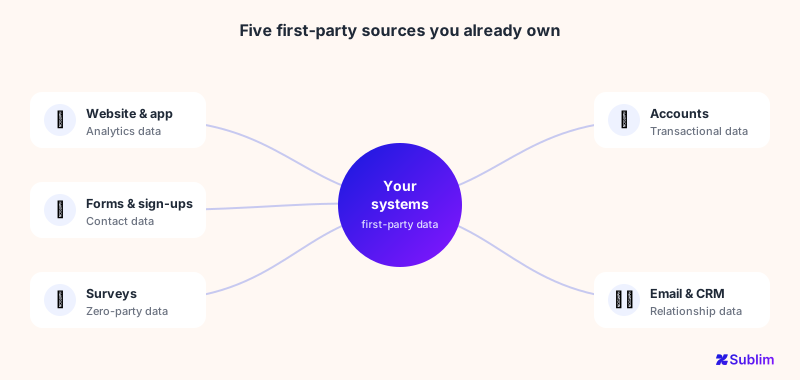
- Analytics data from your website and app: pages, sources, conversions, engagement. This is usually the richest first-party source, and the one most often collected the wrong way (more on that below).
- Transactional data from accounts, orders, and subscriptions: the highest-intent signals you have.
- Contact data from forms, sign-ups, and gated content, collected with clear consent.
- Zero-party data from surveys, preference centers, and quizzes, where people tell you directly what they want.
- Relationship data from your email platform and CRM, tying it all back to a known person over time.
The first-party asset most teams give away: their analytics
Here is the trap. Your web analytics is your single richest source of first-party data, the day-by-day record of who visits, where they come from, and what they do. It should be a first-party asset you own outright. Many popular tools quietly turn it into something else.
Google Analytics is the clearest example. It is free because your visitor data flows to Google, a third party with its own commercial interest in it. Your analytics data, the thing that was supposed to be your own first-party asset, becomes a copy processed by someone else. And the version you get back is incomplete: it needs a consent banner, so it only ever measures the visitors who accept, and it samples away detail once your traffic grows.
So the real question is not whether third-party cookies survive. It is simpler: do you own the record of your own audience's activity, in full, or do you rent a diluted copy of it from a third party? A first-party analytics setup keeps it yours: collected on your domain, hosted under your control, never resold to an ad network, and counting every visitor rather than only the ones who click "accept".
How Sublim helps
Sublim is built so your analytics stays a genuine first-party asset. Your data is hosted in the EU, under your control, and it is never shared with or sold to ad networks. Because it is cookieless, it measures 100% of your traffic without a consent banner, and it is never sampled down to an estimate. In other words, it turns your website traffic into complete, first-party analytics data that belongs to you and no one else. Sublim will not buy you third-party audiences, and it should not: it does the opposite, keeping the data you already own on your side of the line.