For most websites, traffic from AI assistants is still around 1% of total visits. That number is easy to dismiss, and most teams do. It is also the wrong number to look at, for two reasons: it is growing fast, and the visitors behind it convert at rates closer to paid search than to organic. The channel is small, high-intent, and almost completely mismeasured.
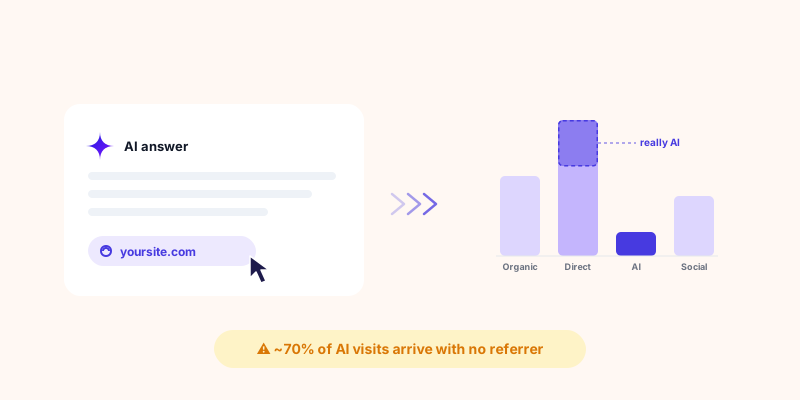
The mismeasurement is the real story. Multiple 2026 studies put the share of AI referral sessions that arrive with no referrer header at roughly 70%. Those sessions don't show up as "ChatGPT" or "Perplexity" in your reports. They land in Direct, mixed in with bookmarks and typed URLs, and the channel quietly looks like nothing. If you judge AI traffic by what your dashboard labels as AI, you are seeing a fraction of it.
This guide covers what AI traffic actually is, why it hides, how to track the part that is trackable, and how to reason about the part that isn't.
First, separate crawlers from visitors
The phrase "AI traffic" gets used for two completely different things, and conflating them is the most common mistake.
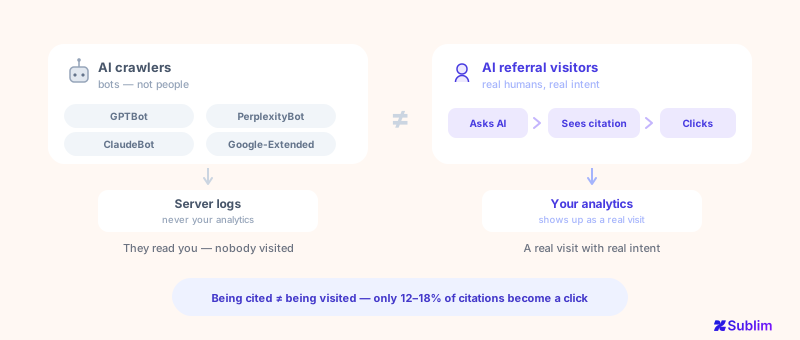
- AI crawlers are bots that fetch your pages to train models or build a search index: GPTBot, OAI-SearchBot, PerplexityBot, ClaudeBot, Google-Extended. They appear in your server logs, not in your analytics, and they are not people. High crawler activity means the models are reading you. It does not mean anyone visited.
- AI referral traffic is a human who asked an assistant a question, saw your site cited or linked in the answer, and clicked through. This is a real visitor with real intent, and it is the traffic worth measuring.
Getting cited by an assistant (the crawler side) and getting clicked from that citation (the visitor side) are different outcomes. One study found that only 12-18% of Perplexity citations turn into an actual click. Being mentioned is not the same as being visited, and your analytics only ever sees the visits.
Why AI traffic hides in Direct
When a browser follows a link, it usually sends a referrer header telling your site where the click came from. That header is how any analytics tool labels a visit as "google", "chatgpt.com", and so on.
AI assistants break this in several ways:
- Many answers are read inside a mobile app or a desktop client, not a browser tab. App-to-browser handoffs frequently drop the referrer entirely.
- Some assistants deliberately strip it. Google's AI Mode, for example, uses a
noreferrerattribute on its links, which makes that traffic untraceable in any client-side analytics tool. - Privacy settings and link wrappers remove or rewrite referrers along the way.
The result: a large share of genuine AI visits arrive with no source attached and get bucketed as Direct. This is not a flaw in one tool. It affects every client-side analytics platform equally, including GA4, including the privacy-first ones. No tool can label a referrer that the browser never sent.
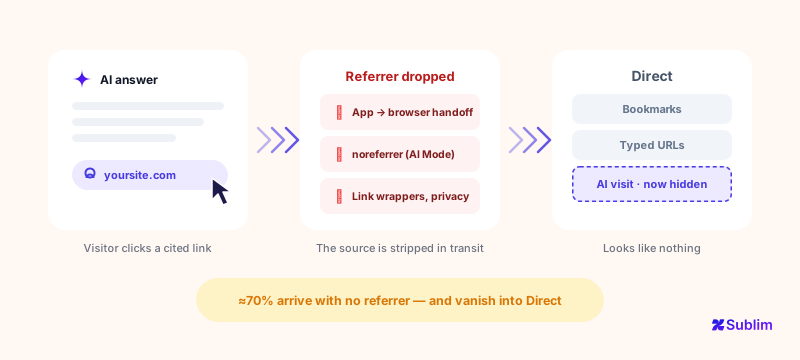
What this means in practice: your reported "AI" number is a floor, not the real figure. The honest way to talk about the channel is "at least this much," never "exactly this much."
The AI sources worth watching
For the sessions that do carry a referrer, these are the domains that account for nearly all measurable AI referral traffic in 2026:
| Assistant | Referrer domains |
|---|---|
| ChatGPT | chatgpt.com, chat.openai.com, openai.com |
| Google Gemini | gemini.google.com, bard.google.com |
| Claude | claude.ai |
| Perplexity | perplexity.ai |
| Microsoft Copilot | copilot.microsoft.com, bing.com/chat |
| Others | chat.mistral.ai, deepseek.com, grok.com, meta.ai, you.com |
The distribution shifts constantly. ChatGPT still leads measurable referrals but its share has fallen from the high-80s a year ago to the low-60s in 2026, while Claude, Gemini, and Perplexity have all gained ground. Regional engines matter too: if a large share of your audience is in France or Europe, Mistral's Vibe (formerly Le Chat; chat.mistral.ai) belongs on your list alongside the global players. Whatever list you build, plan to review it every quarter, because the leaderboard genuinely changes that fast.
Tracking AI traffic in GA4
On May 13, 2026, GA4 added a native "AI Assistant" channel to its default channel group, reaching broad availability across properties in early June. When a click matches a known assistant, GA4 now labels it automatically (medium ai-assistant, channel AI Assistant) with no setup required. It is a real improvement, but three catches matter before you rely on it:
- The recognized list is published only as examples. Google names ChatGPT, Gemini, Deepseek, Copilot, and Grok, but calls the list non-exhaustive and keeps the full referrer list private, so the docs alone can't tell you how any given assistant is classified. In practice, Perplexity is widely reported to still land in Referral, and Claude, named at launch but absent from the current published list, sits in the same grey zone. Google also routes its own AI Overviews and AI Mode clicks to Organic Search, not to AI Assistant. The only way to be certain for a source that matters to you is to check your own GA4 reports: filter by that source and look at its assigned channel.
- It is not retroactive. The channel only classifies traffic forward from May 13, 2026. Every AI visit before that date stays buried in Referral or Direct under your old groupings, so the historical trend never gets rebuilt.
- It inherits the referrer problem. Like any client-side rule, it only catches sessions that arrived with an intact referrer, so the no-referrer majority still falls into Direct.
Rather than guess what Google's private, shifting list does, build a custom channel group as a backstop that catches every assistant you care about by name:
- Open Admin → Data display → Channel groups and create a new group.
- Add a channel (for example "AI Traffic") with a condition where Source matches a regex of the domains above:
chatgpt\.com|chat\.openai\.com| openai\.com| perplexity\.ai| claude\.ai| gemini\.google\.com| bard\.google\.com| copilot\.microsoft\.com| bing\.com/chat| chat\.mistral\.ai| deepseek\.com| grok\.com| meta\.ai| you\.com - Drag the AI channel above Referral in the list, then save.
- Revisit the regex quarterly as new assistants appear.
| means "or", so the rule tells GA4: if the source is chatgpt.com or perplexity.ai or chat.mistral.ai, and so on, file the visit under AI Traffic. The \. escapes each dot so it's read as a literal dot, not a regex wildcard.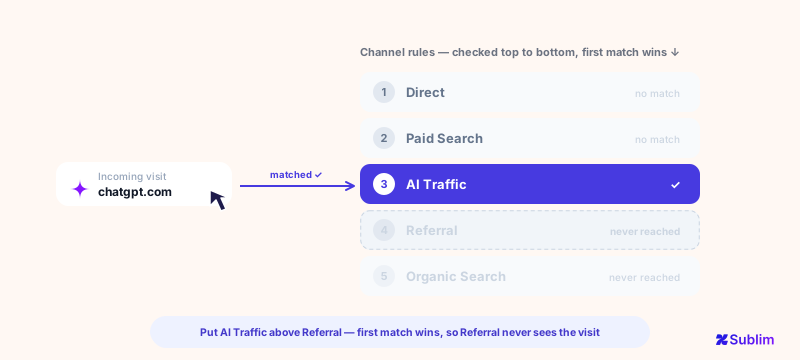
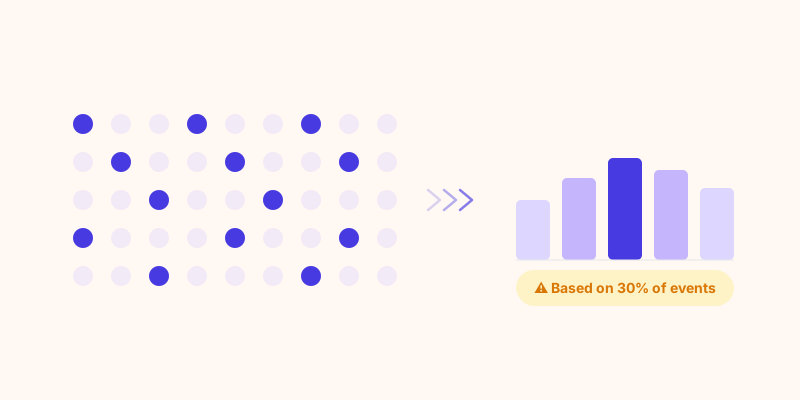
So it's worth doing, but treat it as a partial fix: it's a manual rule you have to maintain, and in GA4 it sits on top of a platform that already samples your reports once volumes get large. A channel that is 1% of traffic is exactly the kind of small segment that sampling rounds away.
Estimating the part you can't see
Since most AI traffic lands in Direct, the question becomes: how do you estimate the hidden portion without guessing? Three signals help triangulate it:
- Direct traffic to deep pages. Nobody types or bookmarks a long article URL or a niche product page. A rise in Direct landing on deep, specific pages (rather than the homepage) is very often unattributed AI and search referrals. Segment Direct by landing page and watch the deep ones.
- Branded search lift. People who discover you in an AI answer often search your brand name afterward to verify. A climb in branded queries that tracks with AI mentions is an indirect but real signal.
- Server logs. Crawler hits from GPTBot, PerplexityBot, and ClaudeBot tell you which pages the models are reading. That doesn't measure visits, but it tells you where citations are likely being generated, which you can cross-reference with Direct spikes on those same URLs.
None of these is exact. Together they turn "we have no idea" into a defensible estimate, which is the most any honest measurement of this channel can offer right now.
Why the channel deserves the attention
It would be reasonable to ignore a 1% channel if those visits behaved like everyone else. They don't. Across 2026 studies, AI referral visitors consistently convert well above organic search, with reported conversion rates in the range of paid search and time-on-site notably higher than typical organic. The intuition behind it is simple: someone arriving from an AI answer has already had their question framed and partly answered, so they land further down the decision funnel than a cold searcher.
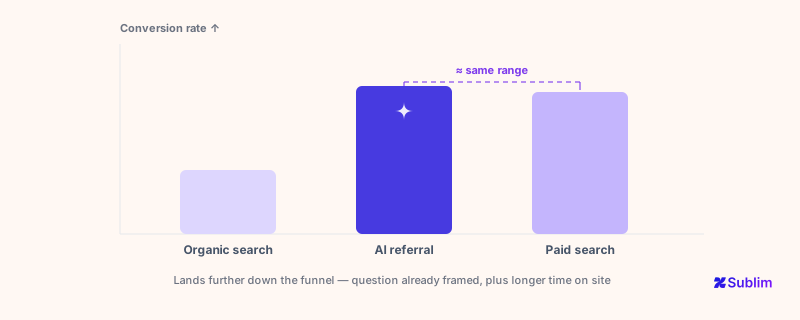
This is why the Direct leakage is expensive. When high-intent AI visits get misattributed to Direct, two things go wrong at once. You undervalue the work that earns AI citations (your content, your SEO, your attribution model), and you overvalue Direct, which becomes a junk drawer that hides your best-converting new channel. The channel is small enough to ignore and valuable enough that ignoring it is a mistake.
How Sublim handles AI traffic
Sublim captures the full referrer on every event and classifies it into an acquisition channel automatically, so visits from ChatGPT, Perplexity, Claude, and the rest surface as their own source out of the box, with no custom regex to build or maintain. Because Sublim never samples, a 1% channel is reported at full resolution instead of being rounded into noise, which matters precisely because AI traffic is small and growing.
What Sublim can't do, and what no client-side tool can do, is invent a referrer the browser never sent. The no-referrer portion is a hard limit of the web, not of any one product. Where Sublim helps is on the rest of the problem: surfacing the trackable AI traffic cleanly, letting you segment those visitors' behavior to see whether they convert, and giving you the Direct-by-landing-page view you need to estimate the hidden share. You measure what is measurable accurately, and you reason about the rest with real signals instead of a sampled guess.