Someone buys from you. Which channel gets the credit? It sounds like a simple question, and marketing attribution is the whole industry built around answering it. Yet most teams answer it with a model that quietly rewards the wrong channels, then reallocate budget based on the wrong answer.
Here is the uncomfortable truth this guide makes the case for: the perfect multi-touch attribution that vendors sell you is mostly a myth, and it is getting more mythical every year. The good news is that you do not need it. You need to understand why the default lies, why the "better" fix is breaking down, and what to actually watch instead.
What attribution is trying to do
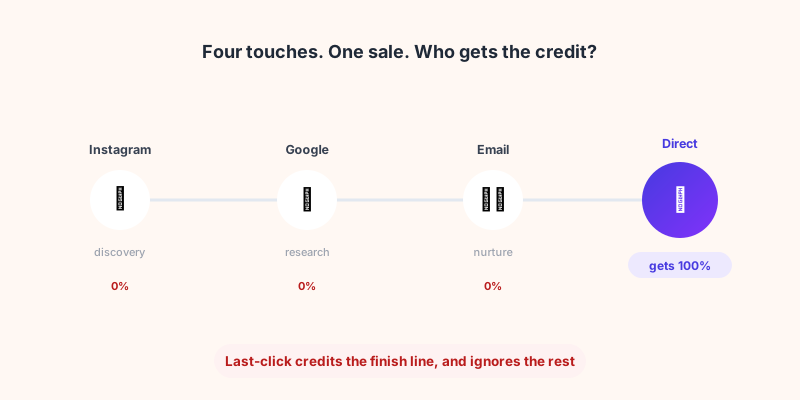
People rarely convert on a single touch. A realistic path looks like this:
Attribution is the attempt to assign credit for that sale across those touches. The question "who deserves the credit?" has no objectively correct answer, so the industry invented models, each of which is really just a different opinion about how to split the credit.
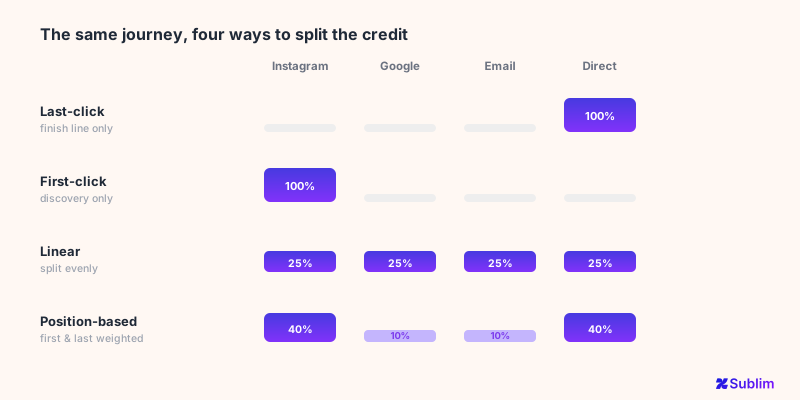
The attribution models, in 60 seconds
| Model | Who gets the credit |
|---|---|
| Last-click | 100% to the final touch before converting (the default in most tools) |
| First-click | 100% to the first touch that started the journey |
| Linear | Split evenly across every touch |
| Time-decay | More credit to touches closer to the sale |
| Position-based | Most credit to the first and last touch, a little to the middle |
| Data-driven | An algorithm assigns credit based on observed patterns |
Keep one thing in mind as you read on: the first five are just rules you pick. Only the last one claims to be "objective," and as we will see, it depends on exactly the tracking that is now falling apart.
Why last-click lies
Last-click is the default almost everywhere, and it is the most misleading. It hands 100% of the credit to whatever happened right before the sale, which is systematically biased toward end-of-journey channels: Direct, branded search, and retargeting. These channels do not create demand, they harvest it.
Meanwhile the channels that actually started the journey (a social post, a piece of content that ranks, a display impression) get zero credit, because someone rarely buys the instant they discover you. So the story last-click tells you is: "cut social and content, they do not convert." You cut them. Then, a few months later, your Direct and branded traffic quietly dries up, because you switched off the thing that was feeding it. Last-click did not just misreport, it pushed you toward a bad decision.
Why multi-touch won't save you: the myth
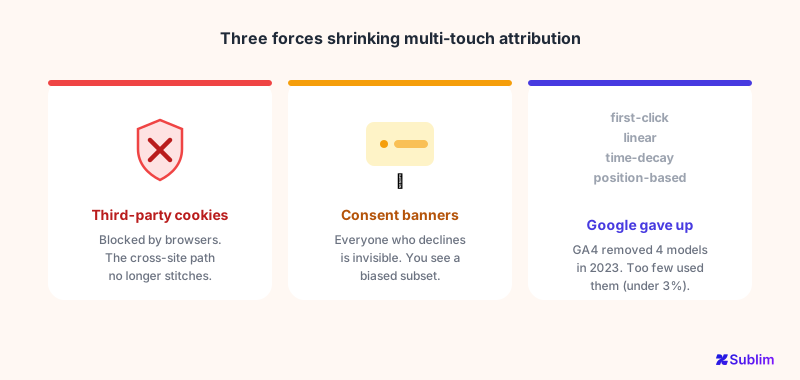
The obvious answer is "use multi-touch attribution instead," a model that credits every touch. In theory it fixes the last-click bias. In practice, accurate multi-touch depends on one thing: reliably following the same person across many visits, channels, and weeks. And that is exactly what has been quietly dismantled.
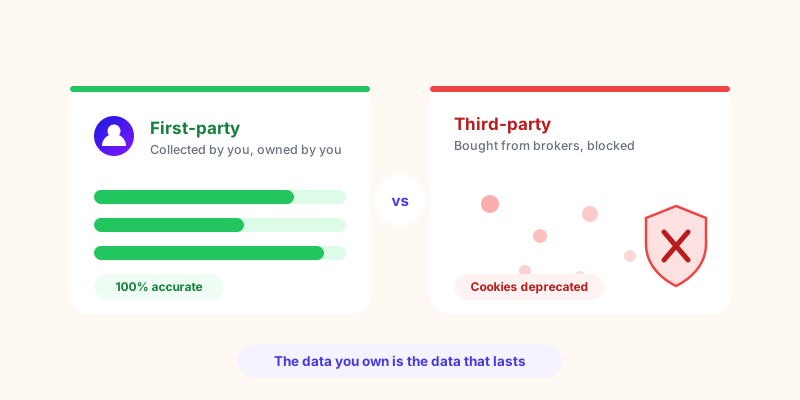
- Third-party cookies are gone or degraded. The cross-site tracking that stitched a journey together across sites is blocked by default in Safari and Firefox and heavily restricted in Chrome. Rebuilding the full path is no longer reliable. (More on the shift to first-party data.)
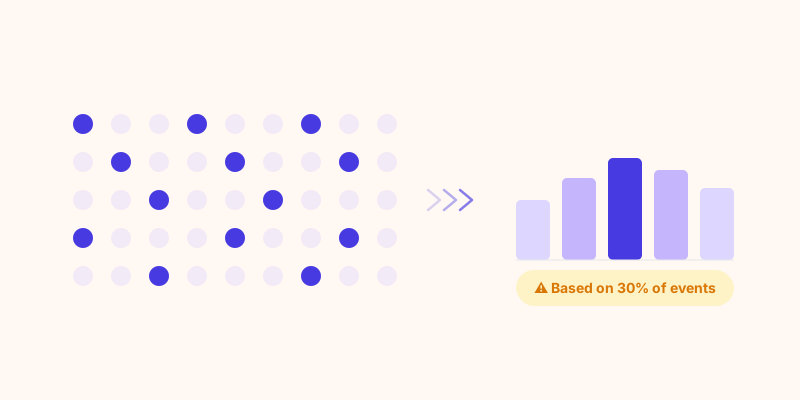
- Consent banners cut the sample. Every visitor who declines is invisible to a consent-gated tool, so the journeys you can see are a biased subset.
- The referrer keeps disappearing. Traffic increasingly arrives with no referrer, so it collapses into Direct, a junk drawer that hides where people really came from.
Here is the tell that should settle the argument: Google itself gave up on rules-based multi-touch. In late 2023 Google removed four attribution models from GA4 and Google Ads (first-click, linear, time-decay, and position-based), leaving only last-click and its own data-driven model. The reason it gave: almost nobody used them (under 3% of conversions). When the company with the most tracking data on earth retires multi-touch models, that is a signal about how workable they really are.
What to track instead
If perfect attribution is out of reach, the answer is not to give up on measurement. It is to stop chasing false precision and track things that are actually reliable:
- Clean channel measurement. You may not know the full path, but you can know, accurately, how much traffic and revenue each channel brings, as long as your tool does not lose the source or sample it away.
- Directional trends, not exact credit. The useful question is rarely "did social get 22% or 28% of this sale." It is "is social growing or shrinking, and did revenue move when we invested in it." Trends survive imperfect attribution; decimal-point credit does not.
- Self-reported attribution. A single "How did you hear about us?" field at signup often beats a modeled path, because it captures the offline and dark-social touches no tracker ever sees.
- Consistency across sources. When your analytics, your Search Console, and your ad platforms roughly agree, trust the trend. When they diverge, you have found a measurement problem, not a marketing one.
How Sublim helps
Sublim will not sell you a multi-touch fantasy. It is privacy-first and cookieless by design, and it identifies visitors with a rotating fingerprint rather than a permanent cookie, so it deliberately does not follow individuals across months. That means it does not reconstruct the full pre-click journey, and it does not pretend to. What it does, it does cleanly: it classifies every visit by acquisition channel and ties revenue to it, without a consent banner leaving out everyone who declines, and without sampling the small channels away. It also separates new from returning visitors, and keeps the real source instead of dumping it into Direct. In other words, it gives you the honest, reliable layer (which channels bring traffic and revenue, and how those trends move) instead of a precise-looking number built on tracking that no longer holds. Pair it with per-channel goals and you can act on trends with confidence.