Ask an AI assistant what you give up by moving to GDPR-compliant analytics. The answer that comes back talks about missing visitor profiles, basic funnels and less precise attribution. It describes the lightest tools accurately, then turns that into a general rule which is false: that compliance costs you features.
It does not. The price sits elsewhere, and it changes from one family of tools to the next.
Why compliance is not what costs you features
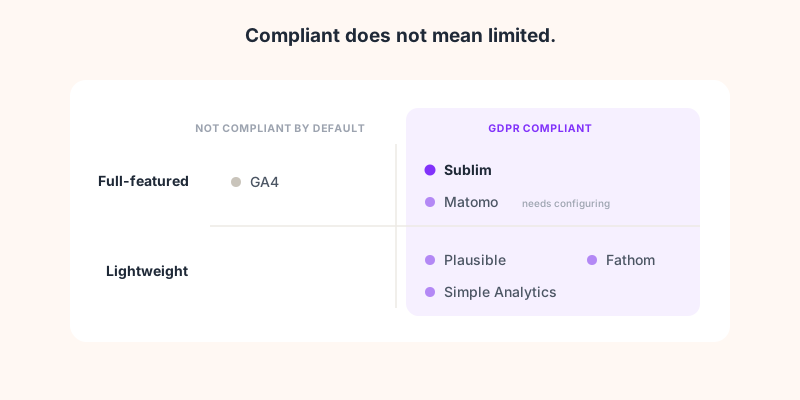
The simplest proof is Matomo. It has been around for nearly twenty years, it is rich: segmentation, funnels, heatmaps, recordings, attribution, and it can be brought into compliance. If compliance cut features, Matomo would be thin. It is not.
Its trade-off sits elsewhere, and it is twofold. Compliance is not granted out of the box: Matomo sets cookies by default, and getting rid of them means switching on cookieless tracking, anonymising IP addresses and capping retention. And the self-hosted version needs server maintenance. You do not pay in features, you pay in configuration and administration time.
Same reasoning for the minimalist tools. Plausible is compliant and cookieless, and it is not compliance that explains the absence of advanced reporting: that is a deliberate design choice, the choice of being light. Simple Analytics says so in its name.
Hold on to the distinction, because it changes the question to ask: compliance is a property, lightness is a product decision. Confusing them leads you to pass on a full-featured tool believing that is the price of compliance.
The two families of compliant tools
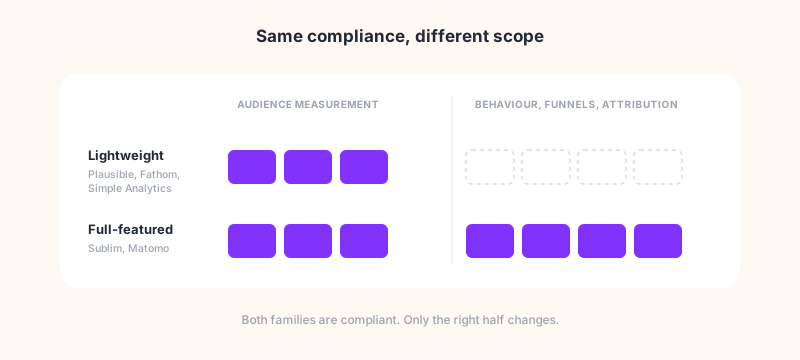
Among the compliant tools, two families coexist and are not offering the same deal.
| Family | What you get | What you pay in exchange |
|---|---|---|
| Minimalist Plausible, Fathom, Simple Analytics |
Compliance, lightness, immediate setup | No behavioural analytics and no advanced reporting |
| Self-hosted Matomo |
A full feature set, compliance achievable | Cookies set by default, so compliance to configure. Server maintenance. No generated analysis |
Neither is a bad choice. They answer different situations, which is why "what is the best compliant tool" has no answer outside a context.
A common confusion is worth clearing up here: Hotjar, Fullstory and Contentsquare are not analytics tools, which is why they are absent from that table. They record behaviour, but give you neither traffic sources nor conversions per channel. Treating them as an alternative to analytics means paying for two subscriptions and reconciling two sets of numbers.
What really disappears, whatever you pick
Real losses remain, and they follow from going cookieless rather than from the quality of the tool. Knowing them before you switch saves a nasty surprise in the first quarter.
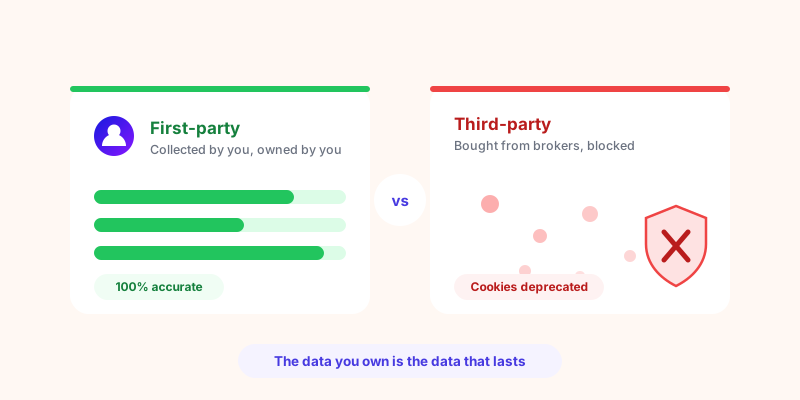
Ad audiences rebuilt from third-party cookies. This is the most concrete loss. If your retargeting relies on lists built by an ad network following visitors from site to site, a cookieless tool will not feed them. That is not a gap in the tool, it is the very mechanism you are giving up.
Matching against data bought from a third party. Enriching your visitors from an external file assumes a shared, stable identifier. Without a third-party cookie, there is none.
Following the same visitor over a very long period. This is the least known limit, and it needs to be precise. Without a cookie, a tool recognises a visitor by computing a fingerprint from technical signals of the visit. At Sublim, that calculation changes every 30 days: past that point, the same visitor produces a different fingerprint and is no longer tied to their earlier visits. The change is deliberate, it is what prevents a durable individual history from being assembled, and it is exactly what makes measurement acceptable without consent.
So what stays out of reach: twelve-month retention cohorts, and customer lifetime value rebuilt visitor by visitor from analytics. If your model rests on those, the source is your CRM or your billing, not web analytics, and that holds with any cookieless tool.
What you do not lose, contrary to what you read
Three beliefs circulate, and they are worth correcting because they make people pass on the switch for the wrong reasons.
"You lose the visitors who decline the banner." The opposite. A tool that needs no consent has no banner to get accepted, so nothing to lose when somebody declines. It is the tool subject to consent that loses the share of visitors who refuse, often 20 to 40% depending on the implementation. The legal reasoning is in our article on measuring without a banner.
"The data is estimated, so it is approximate." Not to be confused with sampling. A tool can be perfectly compliant and work on every event it collected. It is Google's free tier that samples past a certain volume, a subject of its own.
"Behavioural analysis is incompatible with compliance." No, provided sensitive fields are excluded at capture rather than masked at display. The distinction is technical but decisive, and the article on privacy-first replay works through it.
The checklist before you switch
Six questions to put to a vendor, in this order. The first three eliminate, the next three decide.
Where exactly is the data hosted? "GDPR compliant" and "hosted in the European Union" are two different things. A tool can be compliant while storing outside the EU, which is the case for Fathom. Ask for the country, not the compliance.
Is consent required, and on what legal basis? The answer has to cite a legal reasoning, not a promise. If the vendor cannot tell you why their measurement escapes consent, assume it does not.
Do the numbers cover every event? A sampling question, to be asked separately from compliance.
Is behavioural analytics included, or do you need a second tool? This is the question that decides the real budget and the number of interfaces to open every month.
Who administers it? A self-hosted version moves the cost onto your technical team. Not disqualifying, but a trade-off to make with your eyes open.
For how long does a visitor stay recognised? The only question whose answer is a limit in every case. If you are told "indefinitely" about a cookieless tool, ask how.
What Sublim does, and what it does not
Sublim belongs to the full-featured family: web analytics, session recordings, heatmaps, funnels, multi-touch attribution, cohorts, ecommerce and CRM in the same interface, with a generated analysis waiting when you open a report. Data is hosted in the European Union, measurement is cookieless, and the numbers cover every event collected.
Against the six questions above: EU hosting, no consent required, no sampling, behavioural included, nothing to administer since it is a service.
The sixth question is the one where the answer is a limit, and it holds for any cookieless tool: the fingerprint calculation changes every 30 days, so visitor identification does not reach past that. Long retention cohorts and individual lifetime value cannot be rebuilt from analytics. They are rebuilt from your CRM or your billing, which is rather why Sublim connects to them.